

Table OID
Introduction
In NocoBase, Table OID identifies the collection to which a record belongs.
It is commonly used by inheritance collections or scenarios that need to distinguish the source collection of a record. It is mainly a system and metadata capability; ordinary business collections usually do not need it.
Use cases
Table OID fields are suitable for these business scenarios:
- Inheritance collections
- Distinguishing a record source collection
- System metadata
- Collection-level record identification
Create and configure
On the collection's Configure fields page, click Add field and select Table OID to create this field.
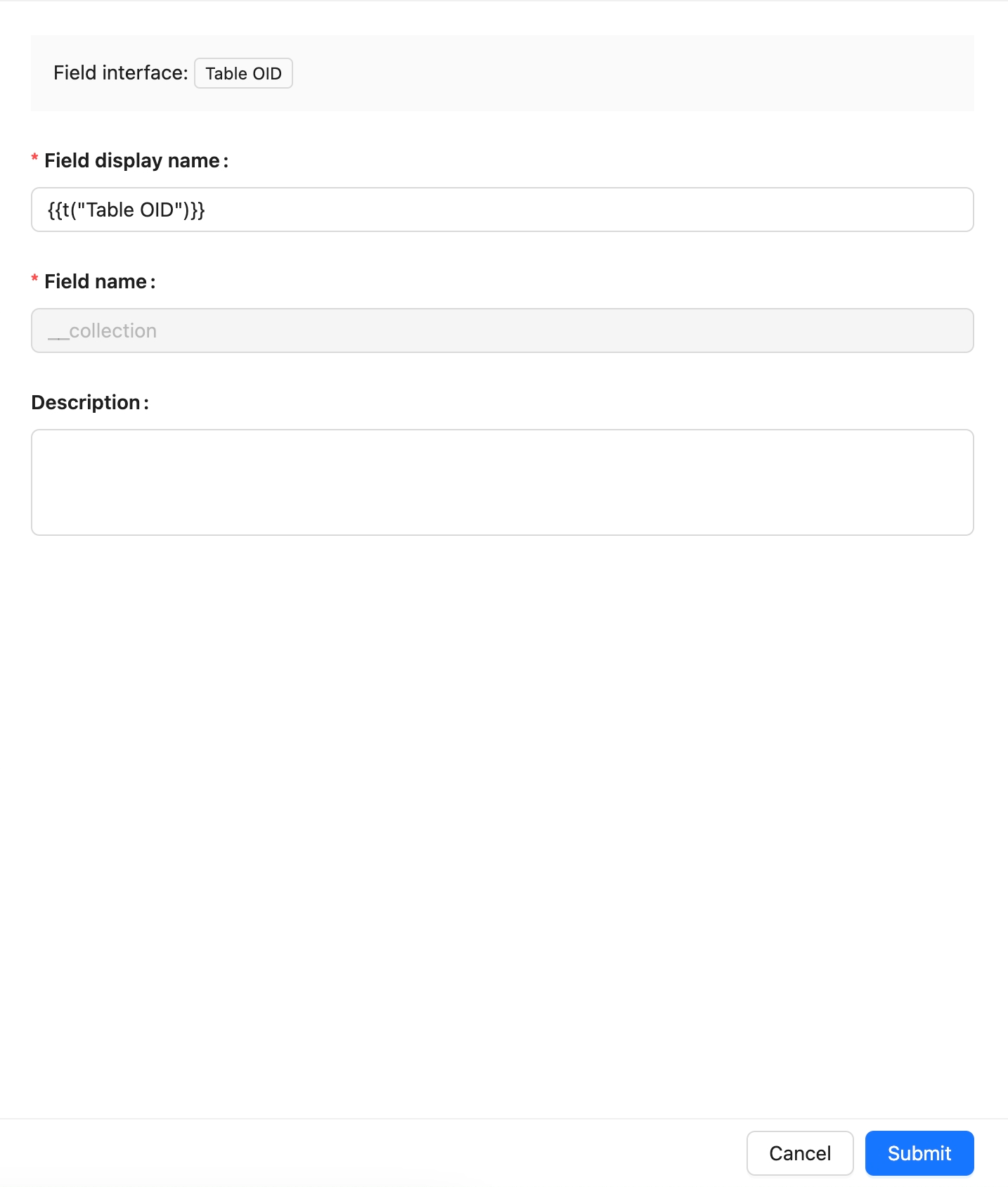
Field names are referenced by page blocks, permissions, workflows, and APIs after creation. Confirm the name before creating the field to avoid later configuration changes.
Field behavior
The default behavior of a Table OID field is as follows:
Edit configuration
After creation, click Edit beside the field to edit its configuration. Edit fields to adjust how they are displayed and used in NocoBase, such as the display name, description, default value, validation rules, or field-specific settings.
When a field comes from a synchronized main-database table, editing usually maps the database field to a NocoBase Field type and Field interface.
Changing a Field type or Field interface is more than changing a display name. It affects field storage, input components, validation rules, filters, and workflow-variable usage. When the field contains substantial existing data, confirm that its data format is compatible first.
Delete field
Click Delete beside a Table OID field to delete it. You can also select multiple fields and delete them in the main data source.
Deleting a Table OID field created in the main database usually also deletes the actual database column and its values. For a synchronized or external-data-source field, the impact depends on the corresponding data source and field origin.
Deleting a field can affect page blocks, forms, filters, permissions, workflows, APIs, imports and exports, and existing data. Confirm that the field is no longer referenced by business configuration before deleting it.
Use in pages
Table OID fields are suitable for system metadata and inheritance scenarios.
Related links
- Fields - Learn about field categories and mapping.
- General collection - Create and manage fields in a collection.